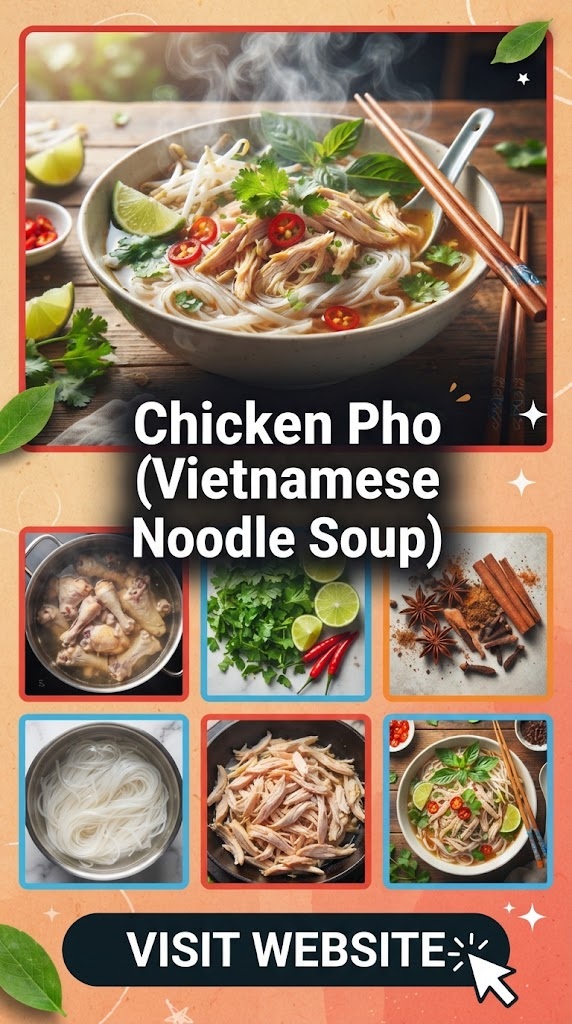
Chicken Pho (Vietnamese Noodle Soup) — A Fragrant, Comforting Homemade Classic
Chicken Pho, known as Phở Gà in Vietnamese cuisine, is a wonderfully aromatic noodle soup made with tender chicken, rice noodles, a deeply fragrant broth, fresh herbs, and bright garnishes. Unlike many heavy soups, chicken pho gets its character from gently simmered aromatics and spices rather than cream or a thick sauce.
The result is a bowl that feels both comforting and refreshing. The broth is warm and savory, the rice noodles are soft and delicate, the chicken is tender, and fresh herbs, lime, and chili add brightness to every bite.
Making pho at home does require a little patience, especially when preparing the broth, but the process is straightforward. Once you understand how to toast the aromatics, simmer the chicken, season the broth, and assemble the bowl, you can make restaurant-style chicken pho in your own kitchen.
This complete recipe includes everything you need: ingredients, preparation, detailed cooking instructions, broth tips, noodle instructions, topping ideas, substitutions, storage advice, reheating instructions, common mistakes, and serving suggestions.
What Is Chicken Pho?
Chicken pho is a Vietnamese noodle soup traditionally made with chicken, rice noodles, and a fragrant broth.
The Vietnamese name Phở Gà translates roughly to chicken pho. It is closely related to beef pho, but the chicken version generally has a lighter, cleaner flavor.
The broth is the heart of the dish. Chicken is simmered with ingredients such as:
- Onion
- Ginger
- Cinnamon
- Star anise
- Coriander seeds
- Cloves
- Fish sauce
- Salt
- A small amount of sugar
These ingredients create the distinctive aroma associated with pho.
The finished soup is served with flat rice noodles and thinly sliced or shredded chicken. Fresh herbs and garnishes are added at the table so everyone can customize their bowl.
Why You’ll Love This Chicken Pho Recipe
There are plenty of reasons to make chicken pho at home.
1. The broth is incredibly flavorful
Toasted onion, ginger, and warm spices give the broth a complex aroma without requiring complicated techniques.
2. It is lighter than many creamy soups
The broth is clear and delicate rather than thick or creamy.
3. You can customize every bowl
Add more lime, herbs, chili, sprouts, or sauces depending on your preference.
4. It makes an impressive family meal
A large pot of pho can feed several people, making it excellent for dinner or weekend gatherings.
5. The leftovers are useful
The broth, chicken, noodles, and toppings can be stored separately and assembled later.
Chicken Pho Ingredients
For the Chicken and Broth
Chicken
- 1 whole chicken, approximately 3 ½ to 4 pounds
- 10 cups water, or enough to generously cover the chicken
- 1 medium yellow onion, halved
- 1 large piece fresh ginger, approximately 4 inches, halved lengthwise
- 2 cinnamon sticks
- 4 whole star anise
- 1 teaspoon coriander seeds
- 3 whole cloves
- 1 tablespoon kosher salt
- 1 to 2 tablespoons fish sauce
- 1 teaspoon sugar, preferably rock sugar or regular granulated sugar
For the Noodles
- 12 ounces dried flat rice noodles
- Water for soaking or cooking according to package directions
Fresh Toppings
- Fresh cilantro
- Thai basil
- Fresh mint, optional
- Green onions, thinly sliced
- Bean sprouts
- Fresh lime wedges
- Thinly sliced jalapeño or Thai chili
- Thinly sliced red onion, optional
Optional Table Sauces
- Hoisin sauce
- Sriracha
- Chili garlic sauce
- Extra fish sauce
Ingredient Form
| Ingredient | Amount | Purpose |
|---|---|---|
| Whole chicken | 3 ½–4 lb | Main protein and broth |
| Water | About 10 cups | Soup base |
| Yellow onion | 1 | Sweetness and aroma |
| Fresh ginger | 4 inches | Warm aromatic flavor |
| Cinnamon sticks | 2 | Classic pho fragrance |
| Star anise | 4 | Sweet licorice-like aroma |
| Coriander seeds | 1 tsp | Citrus-like spice |
| Cloves | 3 | Warm depth |
| Kosher salt | 1 tbsp | Initial seasoning |
| Fish sauce | 1–2 tbsp | Savory umami |
| Sugar | 1 tsp | Balances seasoning |
| Flat rice noodles | 12 oz | Noodle component |
| Cilantro | As needed | Fresh garnish |
| Thai basil | As needed | Fresh herbal flavor |
| Bean sprouts | As needed | Crunch |
| Lime | 2–3 | Acidity |
| Jalapeño or Thai chili | 1–2 | Heat |
| Green onions | As needed | Fresh onion flavor |
How to Choose the Best Chicken
A whole chicken works particularly well for pho because it provides both meat and flavor for the broth.
Look for a chicken that fits comfortably inside your largest stockpot.
A whole chicken also gives you different cuts of meat. The breast can be sliced thinly, while the darker meat from the thighs and legs can be shredded.
If you prefer, you can use bone-in chicken thighs instead. They provide excellent flavor and tend to remain juicy during simmering.
Boneless chicken breasts can also work, but the broth may not have quite as much body.
How to Prepare the Aromatics
One of the most important steps in chicken pho is preparing the onion and ginger.
Instead of simply adding them raw to the pot, lightly char them first.
This gives the broth a deeper aroma and subtle smoky sweetness.
Step 1: Char the Onion
Place the halved onion cut-side down in a dry skillet over medium-high heat.
Cook for several minutes until the surface becomes darkly browned or lightly blackened in spots.
You don’t want the onion completely burned. The goal is a deep char on the surface.
Remove it from the pan and set aside.
Step 2: Char the Ginger
Place the halved ginger in the same dry skillet.
Cook until the cut surfaces develop dark spots and the ginger becomes fragrant.
Turn occasionally so that several sides become lightly charred.
This step takes only a few minutes.
The combination of charred ginger and onion creates a signature aroma that makes homemade pho taste much more authentic.
How to Toast the Pho Spices
The spices should also be gently toasted.
Place the following in a dry skillet:
- Cinnamon sticks
- Star anise
- Coriander seeds
- Cloves
Heat over medium-low heat for approximately 1–2 minutes.
Shake the pan frequently.
The spices should become fragrant, but they should not burn.
Once you can clearly smell the spices, remove them from the heat.
You can place them in a small spice bag or piece of cheesecloth tied securely with kitchen twine. This makes the spices easier to remove later.
How to Cook Chicken Pho Step by Step
Step 1: Blanch the Chicken
Place the whole chicken into a large pot.
Cover it with water.
Bring the water to a boil and allow it to boil gently for approximately 2–3 minutes.
This initial blanching helps remove excess impurities from the surface of the chicken.
Carefully drain the chicken and discard the water.
Rinse the chicken and clean the pot.
This step isn’t absolutely required for every homemade broth, but it helps produce a cleaner-looking pho broth.
Step 2: Return the Chicken to the Pot
Place the cleaned chicken back into the stockpot.
Add approximately 10 cups of fresh water, or enough to cover the chicken.
Add:
- Charred onion
- Charred ginger
- Toasted spice mixture
- Salt
Bring the liquid slowly toward a gentle simmer.
Avoid aggressively boiling the broth.
Why You Should Avoid a Hard Boil
A rolling boil can make chicken broth cloudy and may cause the chicken to become tougher.
Pho is best when the broth gently simmers.
You should see occasional bubbles rising from the bottom of the pot rather than constant vigorous boiling.
A gentle simmer also allows the spices and aromatics to gradually infuse the liquid.
Step 3: Simmer the Chicken
Once the broth reaches a gentle simmer, reduce the heat.
Partially cover the pot.
Simmer the chicken for approximately 45–60 minutes, depending on the size of the chicken.
Check the chicken periodically.
The meat should be tender and cooked through.
The exact cooking time will vary, so use the chicken’s internal temperature and doneness rather than relying only on the clock.
Step 4: Remove the Chicken
Carefully lift the chicken from the pot.
Place it on a large plate or cutting board.
Allow it to cool enough to handle.
Remove the meat from the bones.
You can:
- Slice the breast meat
- Shred the thighs
- Pull apart the drumsticks
- Remove the skin if desired
For traditional-style presentation, thin slices of chicken work beautifully.
Set the cooked chicken aside.
Step 5: Continue Simmering the Broth
Return the bones to the pot if desired.
Continue simmering the broth for another 30–60 minutes.
This gives the broth additional time to develop flavor.
If you are short on time, you can proceed after the chicken is removed, but additional simmering usually produces a more developed broth.
Step 6: Strain the Broth
Place a fine-mesh strainer over a large clean pot or heatproof bowl.
Carefully pour the broth through the strainer.
Discard the onion, ginger, spices, and bones.
You should now have a clear, aromatic broth.
If desired, skim excess fat from the surface.
Some chicken fat is flavorful, so you don’t necessarily need to remove all of it.
Step 7: Season the Broth
Return the strained broth to the stove.
Taste it carefully.
Add fish sauce gradually.
Start with 1 tablespoon and add more if necessary.
Add approximately 1 teaspoon sugar.
Taste again.
You are looking for a balance between:
- Salty
- Savory
- Slightly sweet
- Aromatic
If the broth tastes flat, it may need more salt or fish sauce.
If it tastes too salty, dilute it with a little hot water.
If the flavor is strong but lacks brightness, lime added to the finished bowl can help balance it.
How to Prepare Rice Noodles
Rice noodles require slightly different treatment than wheat noodles.
Follow the package directions because soaking and cooking times vary between brands.
For many dried flat rice noodles, you can soak them in warm water until softened and then briefly cook them in boiling water.
Do not overcook them.
The noodles should be tender but still have enough structure to hold together in the hot broth.
Once cooked, drain them thoroughly.
If they are going to sit for more than a few minutes, rinse them briefly with cool water to prevent excessive sticking.
How to Assemble Chicken Pho
Now comes the fun part.
For each serving, place a generous portion of cooked rice noodles into a large soup bowl.
Add sliced or shredded chicken.
Ladle very hot broth over the noodles and chicken.
The heat of the broth will warm everything beautifully.
Then add your toppings.
A classic combination includes:
- Cilantro
- Thai basil
- Green onions
- Bean sprouts
- Lime
- Chili slices
Serve immediately.
The Best Pho Garnishes
Thai Basil
Thai basil has a distinctive slightly sweet, peppery aroma.
Tear the leaves gently before adding them to your bowl.
Cilantro
Fresh cilantro adds a bright herbal flavor that pairs beautifully with chicken broth.
Bean Sprouts
Bean sprouts provide freshness and crunch.
They can be added raw or briefly blanched.
Lime
Fresh lime is one of the most important finishing ingredients.
A squeeze of lime adds acidity and balances the richness of the broth.
Chili
Thinly sliced jalapeño or Thai chili provides heat.
Start with a small amount and add more as desired.
Green Onion
Green onions provide a mild onion flavor and attractive color.
How to Make the Broth Extra Flavorful
The broth determines the quality of your pho, so a few small techniques can make a major difference.
Char the aromatics
Don’t skip the onion and ginger charring step if you want a deeper flavor.
Toast the spices
Briefly warming the spices releases their natural oils.
Don’t overdo the spices
More spices don’t necessarily mean better pho.
Too much star anise or cinnamon can overpower the chicken.
Simmer gently
Low and slow is better than aggressively boiling.
Taste repeatedly
Seasoning should be adjusted gradually.
How to Make Chicken Pho Ahead of Time
Chicken pho is excellent for meal preparation.
The best approach is to store the components separately.
Keep the broth in one container.
Store the cooked chicken separately.
Store cooked noodles separately if they have already been prepared.
Keep fresh herbs and vegetables in their own containers.
When you’re ready to eat, heat the broth until steaming hot and assemble a fresh bowl.
This prevents the noodles from becoming excessively soft.
Storage Instructions
Allow the broth and chicken to cool appropriately before refrigerating.
Store the broth in an airtight container in the refrigerator.
Store chicken separately.
Fresh garnishes should also be refrigerated in suitable containers.
For best quality, enjoy refrigerated leftovers within a few days.
If you want to keep the broth longer, freezing is an excellent option.
Can You Freeze Chicken Pho?
Yes, but freeze the components separately whenever possible.
The broth freezes very well.
Chicken can also be frozen.
Rice noodles are better prepared fresh because their texture can change after freezing.
To freeze the broth:
- Cool it safely.
- Transfer it to freezer-safe containers.
- Leave appropriate headspace for expansion.
- Label the container with the date.
- Freeze.
When ready to use, thaw in the refrigerator and reheat thoroughly.
How to Reheat Chicken Pho
For the best texture, don’t reheat the entire assembled bowl.
Instead, heat the broth separately.
Prepare fresh noodles.
Place the noodles and chicken in a bowl.
Pour the steaming broth over them.
Add fresh herbs, lime, and other toppings.
This method tastes much closer to freshly prepared pho.
Common Chicken Pho Mistakes
Mistake 1: Boiling the Broth Too Hard
A vigorous boil can make the broth cloudy and may affect the texture of the chicken.
Solution: Keep the broth at a gentle simmer.
Mistake 2: Using Too Many Spices
It can be tempting to add extra star anise and cinnamon.
However, these flavors are powerful.
Solution: Start with modest amounts and adjust after tasting.
Mistake 3: Overcooking the Noodles
Soft, mushy rice noodles can ruin an otherwise excellent bowl.
Solution: Cook noodles according to their package directions and avoid leaving them in hot broth for too long.
Mistake 4: Oversalting the Broth
Fish sauce adds significant saltiness.
Solution: Add fish sauce gradually.
Mistake 5: Skipping Fresh Garnishes
The broth is important, but the fresh toppings provide contrast.
Solution: Serve with lime, herbs, sprouts, and chili.
Chicken Pho Variations
Spicy Chicken Pho
Add extra Thai chili, sliced jalapeño, or chili garlic sauce.
Vegetable Chicken Pho
Add mushrooms, bok choy, spinach, or other vegetables.
Extra-Herby Pho
Use generous amounts of Thai basil, cilantro, and mint.
Ginger-Forward Pho
Add extra ginger for a stronger warming flavor.
Low-Carb Chicken Pho
Replace some or all of the rice noodles with spiralized vegetables.
Keep in mind that this changes the traditional character of the dish.
What to Serve With Chicken Pho
Chicken pho is satisfying by itself, but you can serve it with several Vietnamese-inspired sides.
Try:
- Fresh spring rolls
- Vietnamese-style salad
- Cucumber salad
- Steamed vegetables
- Fresh herbs
- Rice paper rolls
- Pickled vegetables
For a simple dinner, pho with fresh herbs and lime is often all you need.
Tips for Restaurant-Style Chicken Pho at Home
Use a large pot
The chicken should have enough room to simmer comfortably.
Don’t rush the broth
A few extra minutes of gentle simmering can improve the flavor.
Keep garnishes fresh
Fresh herbs should look vibrant and fragrant.
Serve the broth very hot
Hot broth warms the noodles and chicken immediately.
Use large bowls
Pho needs enough room for noodles, chicken, broth, and toppings.
Season carefully
The broth should be flavorful before the garnishes are added, but not overwhelmingly salty.
Frequently Asked Questions
Is chicken pho healthy?
Chicken pho can be part of a balanced meal. It contains protein from chicken, carbohydrates from rice noodles, and fresh herbs and vegetables from the toppings.
The nutritional content depends on portion size and ingredients.
Can I use chicken breasts?
Yes. Chicken breasts can be used, although whole chicken or bone-in pieces generally provide more flavor.
Can I use chicken thighs?
Absolutely. Chicken thighs are especially forgiving because they stay juicy during cooking.
Do I have to use fish sauce?
Fish sauce contributes classic savory depth. If you cannot use it, you can experiment with soy sauce or another savory seasoning, although the flavor will be different.
Can I make pho without star anise?
Yes. The soup will still work, but star anise contributes a recognizable pho aroma.
Can I make the broth the day before?
Yes. In fact, making the broth ahead can be convenient. Refrigerate it promptly and reheat it thoroughly before serving.
Why is my pho broth cloudy?
The most common reason is vigorous boiling. Excessive agitation can cause proteins and particles to remain suspended in the broth.
A gentle simmer and careful straining can help produce clearer broth.
Can I add hoisin sauce directly to the broth?
You can, but it is generally better served at the table. Adding it directly to the broth can change the character of the soup and make it sweeter.
Nutrition Information
Approximate nutrition per serving will vary depending on the chicken used, noodle quantity, fish sauce, and garnishes.
A typical bowl provides:
- Protein from chicken
- Carbohydrates from rice noodles
- Fat from chicken and broth
- Sodium from salt and fish sauce
- Vitamins and minerals from fresh herbs and vegetables
For a lighter bowl, use more herbs and vegetables and a moderate portion of noodles.
Recipe at a Glance
Recipe: Chicken Pho
Cuisine: Vietnamese
Course: Main Course, Soup
Preparation Time: 20 minutes
Cooking Time: 1½–2 hours
Total Time: About 2 hours
Servings: 6
Difficulty: Moderate
Complete Chicken Pho Recipe
Ingredients
Broth
- 1 whole chicken, 3½–4 pounds
- 10 cups water
- 1 yellow onion, halved
- 4-inch piece fresh ginger, halved
- 2 cinnamon sticks
- 4 star anise
- 1 teaspoon coriander seeds
- 3 cloves
- 1 tablespoon kosher salt
- 1–2 tablespoons fish sauce
- 1 teaspoon sugar
Noodles
- 12 ounces flat rice noodles
Garnishes
- Fresh cilantro
- Thai basil
- Green onions
- Bean sprouts
- Lime wedges
- Jalapeño or Thai chili
- Thinly sliced red onion, optional
Optional Sauces
- Hoisin sauce
- Sriracha
- Chili garlic sauce
Detailed Cooking Method
1. Prepare the aromatics
Halve the onion and ginger.
Char both in a dry skillet until fragrant and browned in places.
2. Toast the spices
Toast cinnamon, star anise, coriander seeds, and cloves for 1–2 minutes.
Place them in a spice bag if desired.
3. Blanch the chicken
Cover chicken with water and boil for 2–3 minutes.
Drain and rinse.
Clean the pot.
4. Start the broth
Return chicken to the pot.
Add fresh water, onion, ginger, toasted spices, and salt.
Bring to a gentle simmer.
5. Cook the chicken
Simmer gently for approximately 45–60 minutes, or until cooked through.
Remove chicken and let it cool.
6. Remove the meat
Separate the chicken from the bones.
Slice or shred the meat.
7. Develop the broth
Return bones to the broth if desired.
Continue gently simmering for another 30–60 minutes.
8. Strain
Strain the broth through a fine-mesh strainer.
Discard the solids.
9. Season
Add fish sauce and sugar gradually.
Taste and adjust the seasoning.
10. Prepare noodles
Cook or soak rice noodles according to package instructions.
Drain well.
11. Assemble
Place noodles into bowls.
Add chicken.
Pour very hot broth over the top.
12. Garnish
Add cilantro, Thai basil, green onions, bean sprouts, lime, and chili.
Serve immediately.
Final Tips for the Best Chicken Pho
The secret to outstanding chicken pho is balance.
You want the chicken broth to be aromatic without tasting overwhelmingly like spices. The noodles should be tender without becoming mushy. The chicken should remain juicy. Fresh herbs should provide contrast, while lime should bring everything together.
Take your time with the onion, ginger, and spices. These small steps have a big impact on the finished broth.
Most importantly, taste the broth before serving. If it needs more savory flavor, add a little fish sauce. If it tastes too salty, dilute it slightly. If it needs brightness, let the lime do the work once the bowl is assembled.
Chicken pho is more than just a bowl of noodles and broth. It is a combination of fragrant spices, tender chicken, fresh herbs, chewy rice noodles, and bright citrus. Once you make it at home, you can easily adjust the toppings and seasoning to create your perfect bowl.
Whether you’re looking for a comforting family dinner, a warming weekend meal, or a homemade alternative to restaurant pho, this Chicken Pho (Vietnamese Noodle Soup) is a delicious recipe to keep in your kitchen collection.
